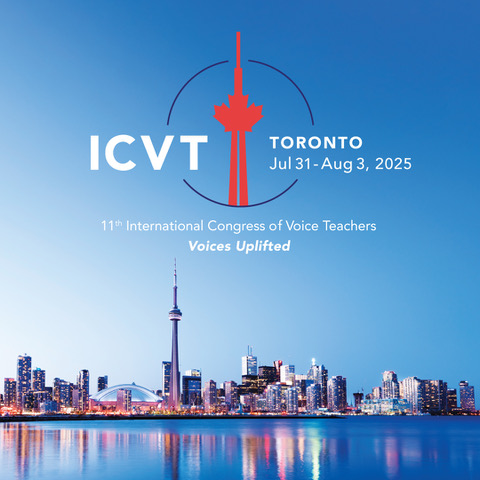
ICVT Congress Report Toronto August 2025
by Ellen Pieterse, EVTA President
The ICVT Congress opened with a powerful and celebratory opening session centered on music and community. In the large church where all participants gathered, we first listened to a Native singer and watched a traditional dance. This was followed by a moving classical performance of contemporary works by Native composers, performed by strings, piano, and voice. The texts reflected the lived experiences of people with Indigenous backgrounds and set a meaningful tone for the congress. Performances by children were especially inspiring, demonstrating how deeply the younger generation is engaged not only with popular music and musical theatre, but also with classical and operatic repertoire.
The opening day also featured contemporary commercial music and an inspiring keynote address by Karen Slack. She shared her personal journey toward becoming an internationally acclaimed singer, emphasizing the importance of teachers who believed in her, supported her at crucial moments, and encouraged her to take each successive step in her artistic development.
Thursday, July 31
I did not attend the early morning sessions as I was preparing my panel presentation together with colleagues. Our panel focused on building global connections for young singers through singing and song. The panel consisted of approximately twelve contributors, including Past-President of NATS Karen Brunssen, and was divided into three working groups: advocacy (how to encourage acceptance of children singing), repertoire, and action. I participated in both the advocacy and action groups, where we discussed concrete strategies for reintegrating music — and especially singing — into primary education.
That evening, a gala reception was held at the Art Gallery of Ontario. The venue was beautiful, and participants were able to view part of the gallery’s collection. The atmosphere was warm and celebratory, with many opportunities to reconnect with colleagues, meet new people, and engage in meaningful networking.
Friday, August 1
The day began with a complimentary breakfast at the Chelsea Hotel, which allowed participants to start the day together. During breakfast, the first presentation took place. The congress’s main sponsor introduced his product, the app Appcompanist. This app offers a wide range of piano accompaniments in all imaginable keys and allows users to adjust tempo and add fermatas. It is an extremely useful tool for teaching and practice when a pianist is not available. I have personally used the app to study complex contemporary repertoire by the American composer Lori Laitman, which helped me arrive well prepared for rehearsals with my pianist.
The next lecture was given by Austrian pedagogue Christian Herbst and was titled The Piranha-Infested River of Voice Pedagogy. Informative, humorous, and engaging, the lecture explored evidence-based voice pedagogy and vocal registers. Herbst demonstrated how perceived register “breaks” are often auditory phenomena rather than acoustic realities, highlighting that both scientific research and pedagogical experience have valid perspectives. The lecture was both enlightening and highly entertaining.
This was followed by a presentation from Kari Ragan on the work of Manuel Garcia and his vocal pedagogical methods. Ragan illustrated how Garcia’s approach was not only effective in teaching singers, but also in rehabilitating voices in difficulty. The relevance of his work remains strikingly contemporary and inspiring.
After a very full morning, I chose to take a break during the afternoon sessions. Lunch with colleagues took longer than expected, and upon returning to the venue I encountered several colleagues I had not seen in some time. These conversations and networking opportunities proved deeply meaningful and inspiring, even though I missed the scheduled sessions.
That evening, I attended a lecture-recital by an undergraduate singer who is transitioning into a transgender man. Together with his teacher, he shared his experience of navigating vocal changes caused by testosterone while aspiring to a career in opera. What stood out was their sense of isolation and the lack of available literature. I was able to recommend a book that has been invaluable in my own work with transgender male singers. The student, Luca, later approached me to discuss possibilities for master’s studies in Europe, and the following day we had a productive conversation about potential opportunities.
I also attended a lecture-recital dedicated to Canadian art song, focusing on the repertoire of composer Violet Archer. Her music was compelling and expressive, and I intend to purchase and include some of her works in future recital programming.
Saturday, August 2
This was the day of my own master class, presented together with colleagues Sara Holman and Sandra Oberoi. Our session, titled Three Voices, One Vision: A Reimagined Master Class, explored the concept of team teaching. We worked with three students at different stages: a 16-year-old high school student attending her first master class, an undergraduate student, and a young professional who had recently completed her master’s degree.

Our approach involved working simultaneously with one student, taking turns in leading while allowing the others to contribute when appropriate. We consciously built upon one another’s work rather than redirecting it, adding layers from our individual pedagogical perspectives. Coming from three different continents, we brought diverse cultural backgrounds and areas of specialization, while sharing a common pedagogical foundation. The experience was joyful, efficient, and deeply collaborative. The students reported feeling supported and enriched by the process, and the audience responded with great interest. Many colleagues approached us afterward to share feedback and to discuss the potential of team teaching as a pedagogical model.

That afternoon, poster sessions were held at the Toronto Conservatory, an architecturally striking building where historic and modern structures are seamlessly integrated. While I attended few posters in depth, the sessions were highly valuable due to the many conversations with colleagues interested in team teaching and collaborative pedagogy.
Later in the afternoon, Karen Slack led a performance class (intentionally not labeled a master class), working with young singers primarily through close attention to the musical score. Her approach was clear, practical, and supportive.
That evening, I did not attend the concert but instead had dinner with Edwin Pitt Mansfield to discuss several matters related to EVTA. After a demanding day that included both my own master class and the performance class, this felt like a necessary and welcome conclusion.
Sunday, August 3
The day began with a slower pace. At 10:00 a.m., I attended the lecture Beyond Mechanics: Biotensegrity in the Voice Studio by Jeremy Ryan Mossman. This was an outstanding and highly informative presentation on fascia and its relevance to voice pedagogy. The concepts were presented in a way I had not encountered before, and I would welcome the opportunity to hear more from him in a European context.
I then remained within the fascia-focused theme by attending a presentation by Madeline Miskie on self-myofascial release. While informative, this was clearly an early presentation in her academic trajectory and would benefit from further development.
In the afternoon, I attended a lecture by Kenneth Bozeman and Robert Loewen on rehabilitation strategies for the aging male singer. While solid, the material was largely familiar. This was followed by Singing Through Change: Voices in Midlife, Menopause, and Beyond, presented by Joanne Bozeman and Kathy Price. Having attended a similar lecture in 2022, I found this iteration particularly relevant as I am now personally experiencing these changes. It was striking to learn that systematic research into the effects of hormones on singing has only begun in recent years.

I skipped the final session in order to speak with Alexis Davis, current president of NATS, about matters related to the International Initiatives Committee. The closing ceremony took place in an extremely hot venue, which made sustained concentration difficult. Although the content was important and well-presented, the physical conditions overshadowed the experience.
The congress concluded with farewells, after which I joined colleagues for a final drink at an unconventional cocktail bar where custom-made cocktails provided a memorable — if rather expensive — ending to an intense and enriching congress.